Recommendations

Hello! Shalom! Aloha! Mabuhay!

If this is your first visit to Modern Apocrypha, I have only two recommendations for continuing on with minimal confusion:


1) Please begin with the first introductory post (found HERE) and work your way forward. Almost all the posts on this blog flow chronologically and will make more sense with the background and context of previous ones. Jumping in anywhere might be disorienting.

2) Please read along in the texts posted off to the right. I try not to summarize too much in the commentary and discussion, and being at least somewhat familiar with what we're discussing or I'm commenting on will be most beneficial and edifying for all involved. Plus, going along with the theme of this blog, any hidden truths to be brought to light will be found within the text itself and not necessarily within my ramblings.

Okay, fine, three recommendations:

3) Please read with an open heart, mind, and spirit. See what truths you can find in these works--ones which speak to you. Namaste : )

Thursday, January 29, 2015

SURAN 1 - SECRETS OF THE ANCESTORS


Our story begins with Suran, a good man who follows his heart, hunting and gathering in the mountains. His old, wise uncle, Ngameke, follows him to share an important secret with him concerning their ancestors and teach him about the laws and commandments of God. As a fervent animist or polytheist, Suran has no idea what Ngameke's talking about, but he's curious so he follows him into the jungle. 

This name, Ngameke, is intriguing to me; it seems to be unique in the Aklatan, or at least it's unique sounding. For fun, I tried to see if I could make any sense of it. (I don't know any of the Filipino languages.) In Cebuano, nga = "that", meke = a type of noodle dish. In Maori, nga = "breath/to breathe" or simply "the", meke = "to punch/hit". In Mapuche (indigenous Chilean), nga = participle/"the", meke = "busy". Filipino and Polynesian languages belong to the same Austronesian language family, so we should expect some similarities and cognates. Also, there have been some cool archaeological, linguistic, and genetic discoveries over the past decade or so showing ancient connections between Polynesians and Mapuche peoples, but we'll have to save going into that for another time : )

In any case, Suran and Ngameke travel along jungle trails for several days until they come to the base of a cliff hidden by vegetation with water flowing down from the top, when Ngameke produces a bamboo container. He removes the stopper and pulls out several records written by their ancestors. Suran is amazed and reads them, which contain the history of a group of people--a branch of Shem--who traveled to the islands long before. (Incidentally, Suran, a polytheistic hunter-gatherer from several centuries BC is literate. Usually writing systems and literacy follow the advent of agriculture and more complex forms of social organization.)

As with any good history from the ancient Middle East, it begins with the genealogy of the participants to give context to the events--in this case, Shem's lineage for several generations down to Ophir. This is part of what is know as the Table of Nations in the Bible. The genealogy here in Suran 1 is nearly identical to the those found in Genesis 10, 1 Chronicles 1, and Josephus' Antiquities of the Jews. However, it is unique in many ways. (I was going to list off the main differences, but here's a nice little chart instead ; )


Reading the ancestral records, Suran learns that some of Ophir's sons (a "band of ten") traveled for many years until they reached the northern shores of the islands, where they established a righteous order (i.e., priesthood order) among the people and adopted many islanders into it. But after many years, the people returned to their animism/polytheism, and the righteous band dwindled until there were few of them. After many years a broken branch of the tribe of Levi also came to the islands (we'll talk more about this later), and Ruman interjects that he's recorded many more things concerning the ancestors in the Aklatan. But finally, Ngameke admits he is now the last of this righteous lineage.

I spent weeks of research going down this Ophir (and Tarshish, and Havilah, etc.) rabbit hole, and then the holidays came, which is why this post is two months late. From the Biblical tradition, we find that Ophir is a foreign land to the east accessible by the sea and laden with gold and other precious items. (Later traditions equate it with Yemen, India, Pakistan, etc.) David had set aside gold from Ophir for the temple he'd never see. Solomon's servants went with Hiram's navy to fetch gold, sandalwood (almug/algum), and precious stones from Ophir for the temple. (The type of sandalwood mentioned is only found in the east Indian Ocean and Pacific Islands.) Jehoshaphat tries to send ships to Ophir for gold, but they're wrecked in port (Gulf of Aqaba). Job, Psalms, and Isaiah all mention the glory of the "gold of Ophir". We'll talk more about the traditional geography of Tarshish and Havilah in Suran 6.

However, there's another fun tradition of Ophir that aided Magellan in his journey to and through these east Asian islands. Volume 3 of Coleccion General de Documentos Relativos a las Islas Filipinas contains the official documents of Magellan's voyage and his captain's logbook. Document 98 (AD 1519-1522) (pp. 112-138) describes how to locate the land of Ophir, saying it was "in front of China towards the sea, of many islands where the Moluccans, Chinese, and Lequios met to trade." According to this account, Ophir would be found somewhere between mainland China and the Indonesian archipelago of Maluku. (Hint: the Philippines are the only islands directly between the two.)

But this document and other Spanish books of the time mention these enigmatic "Lequios", who have been identified by modern historians as Okinawans, Koreans, Vietnamese, etc. The Lequio ships were favorite targets of the Spanish East Indian navy during the latter end of the 16th century, as they were always laden with gold and silver. However, Document 98 describes Lequios as large, bearded, and light-skinned (features uncharacteristic of SE Asians) and only interested in trading gold and silver at Ophir. Those Spaniards with some Biblical knowledge believed them to be remnants of Hebrew or Phoenician sailors and/or merchants (i.e., from the time of Solomon and Hiram) who established permanent trading posts in and around Ophir.

I found one author who claims that this Spanish transliteration "Lequio" could be a derivation and/or corruption of the Hebrew verb LAQAT or one of its forms, meaning "to gather, glean, collect, assemble", a fitting title and description of the servants of Solomon and sailors of Hiram sent to gather gold and precious things for the temple. (Or as a fun aside, it could be a derivation of Lehi, with a hard H shifting to a K sound, meaning Lequios are Lehites ; ) But more than likely Lequios is connected to Lekas island mentioned in Suran 6.

Saturday, November 22, 2014

SURAN INTRO - RUMAN'S INTRO TO THE AKLATAN

At long last, we're finally into the actual text of the Akaltan! (It only took 6+ months ; )

Right off the bat, we're introduced to Ruman, the equivalent of a Mormon-Moroni character--the final believer and record keeper as well as compiler, abridger, and narrator of the Aklatan. As with Mormon in the Book of Mormon, whenever we hear things in a narrative, third-person voice, it'll almost always be Ruman speaking. His introduction here is also similar to Moroni's "Title Page", as it explains his method and purpose for compiling this record.

Method
Ruman says that he wrote on copper sheets so that the record would last until it's revealed in future generations. (He'll explain more about how he fashioned these plates in his book at the end of the Aklatan.) He also tells that he wrote them in a language of his own creation--a code of sorts--so that if the sheets are found by the believers' enemies, who have sworn to destroy everything connected to the Gospel of Christ, they would neither comprehend the words nor their value.

This reminded me of the descriptions in the Book of Mormon of their method of recording. Lehi, the first record keeper (the English translation of his record being lost by Martin Harris), could read Egyptian:
For it were not possible that our father, Lehi, could have remembered all these things, to have taught them to his children, except it were for the help of these [brass] plates; for he having been taught in the language of the Egyptians therefore he could read these engravings, and teach them to his children... (Mosiah 1:4)
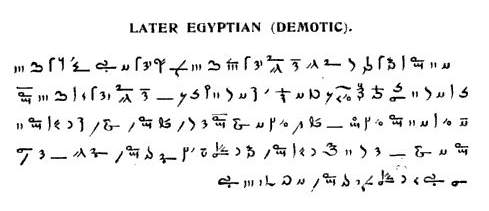
It doesn't specify, but "the language of the Egyptians" could mean any or all of these written forms: formal hieroglyphic, hieratic of religious texts, and/or early demotic of administrative, legal, and commercial documents.

(This is the same text written in the three systems.)


It's apparent from this that Lehi, and later Nephi, followed the pattern of the Brass Plates--Egyptian engravings on metal plates--to keep their own lasting records. Nephi explains their family code:
I, Nephi,... was taught somewhat in all the learning of my father;... therefore I make a record of my proceedings in my days.
Yea, I make a record in the language of my father, which consists of the learning of the Jews and the language of the Egyptians. (1 Nephi 1:1-2)
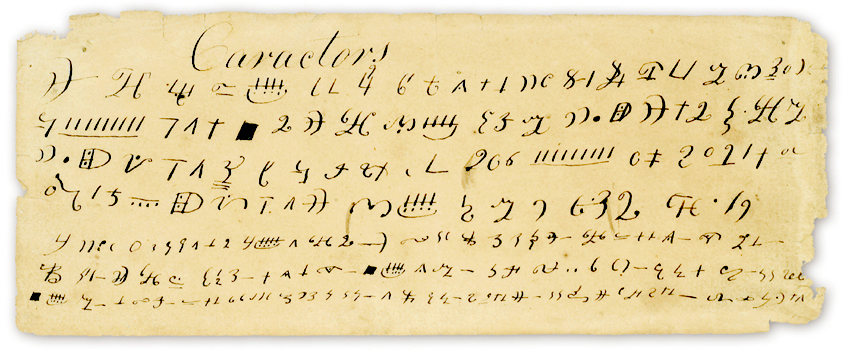
Though novel in 1829, this kind of mixed writing system--communicating one language in the symbols of another--now appears to have been prevalent in the ancient Mid-East at the time of Lehi and before, and Moroni explains why they wrote in Egyptian and that it'd been changed over the Nephite millennium to something like this:
And now, behold, we have written this record according to our knowledge, in the characters which are called among us the reformed Egyptian, being handed down and altered by us, according to our manner of speech.
And if our plates had been sufficiently large we should have written in Hebrew; but the Hebrew hath been altered by us also; and if we could have written in Hebrew, behold, ye would have had no imperfection in our record.
But the Lord knoweth the things which we have written, and also that none other people knoweth our language; and because that none other people knoweth our language, therefore he hath prepared means for the interpretation thereof. (Mormon 9:32-34)
Which brings us full circle to Ruman. Echoing Moroni, Ruman also has faith that God would provide a means for his coded record to be translated and the Aklatan to be revealed to a chosen people in the future who would then lay the foundation for peace and prosperity.

Purpose
On the Title Page to the Book of Mormon, Moroni declares that the purpose of that record is 1) to remind remnant Israel of God's dealings and covenants with their ancestors and 2) to convince all that Jesus is the Christ. Ruman also explains that he compiled the stories, histories, and prophecies of the Aklatan 1) so that future generations and inhabitants of the islands would know the truth of their ancestors and God's word concerning them and 2) to bear witness that Jesus is the Son of God and that salvation comes through Him and His word. The similarities are striking.

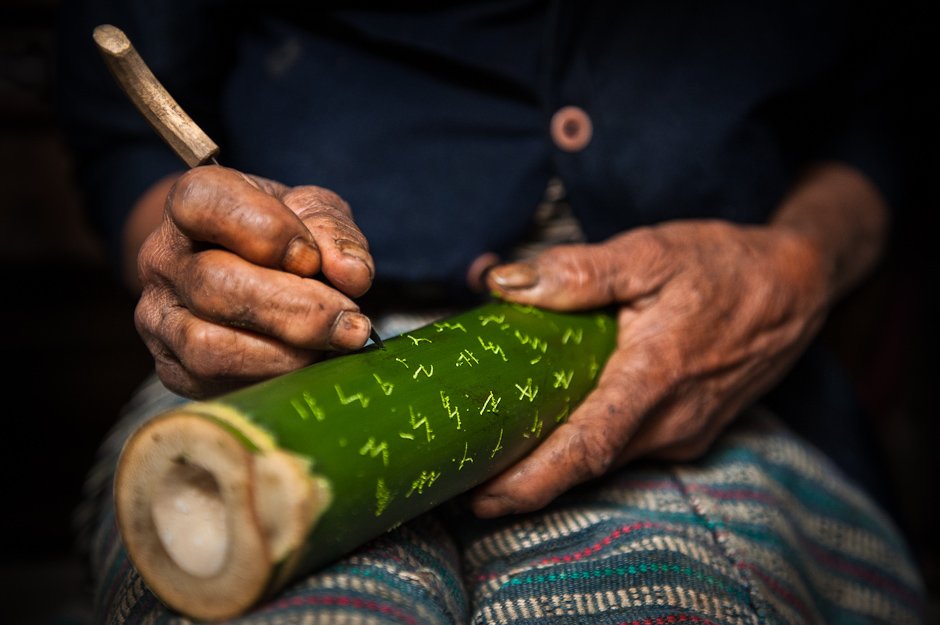
Ruman then begins his record with the writings of the prophet Suran taken from a great scroll. The remainder of the record comes from many other scrolls, bamboo records, and other sacred writings in his possession that contain the words and preachings of many prophets. Like Mormon, Ruman has written only those things that the Holy Ghost testified were important to be preserved and passed on.

From archaeological, historical, and modern-day evidence from the Philippines, Taiwan, Indonesia, etc., we can visualize these scrolls, bamboo records, and the like as similar to these:


Sunday, November 16, 2014

EZEKIEL 1-9 - THE MILLENNIAL TEMPLE

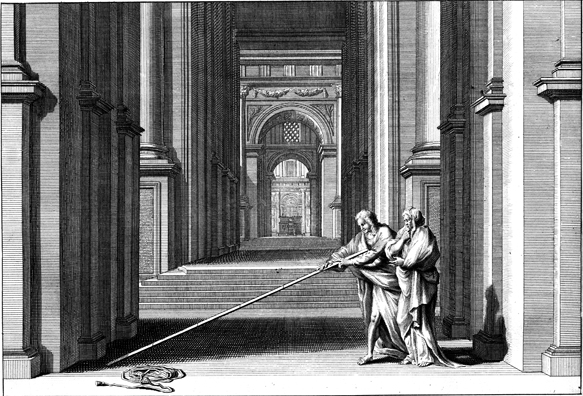
In the 25th year of Judah's Babylonian captivity (572 BC), a 50-year-old Ezekiel receives one of the most amazing visions of the Bible (Ezekiel 40-48), one of the millennial temple at Jerusalem and the Lord's holy city. His tour guide, an angel ("man") with radiant bronze skin, escorts him throughout the temple compound, carefully noting every possible architectural measurement. Biblical scholars have debated whether this overload of architectural minutiae was merely to demonstrate the reality of Ezekiel's vision--that he couldn't have made it all up--or rather, that the Lord wanted it to serve as an actual blueprint for that same future temple and its surroundings--a prophecy, then, with great potential for self-fulfillment.

You can find hundreds of outlines, diagrams, and models of Ezekiel's temple online, and we could go on forever on all of the details and their possible significance. But I'll just post links to a few fun 3D models (except for the glory of God depicted as flying fiery wheels ; ), and add a few comments of interest. (All videos courtesy of Bible Prints.)

Ezekiel 40
Ezekiel 41
Ezekiel 42-43

First off, the temple is going to be quite a substantial construction. With a cubit equalling about a foot-and-a-half (give or take) and a reed equalling about six cubits (give or take), the outer wall of the temple sanctuary will enclose almost 1 1/2 square miles, or roughly the size of Central Park. The central temple compound itself is about 250 yards on each side, or enough area to fit about eight football fields. The chapters don't specify the height of the temple itself, only that it will have three stories of usable rooms; however, the gates of the compound will be about ten stories tall!

Ezekiel mentions in passing the "sons of Zadok", but it's not until Ch 5 (or 44) that their importance is discussed. In that chapter, the Lord chastises the priests of Judah for allowing foreigners, unbelievers, and the unrighteous into the temple. Essentially, the Lord's anointed ones, who should've personally kept the temple clean and pure, had passed the buck and delegated that responsibility to security guards and other temple workers. Apparently, the sons of Zadok were the only ones who cared for their charge and magnified their calling while the rest of Israel and Judah fell into apostasy. It's important to note that Zadok served as the first high priest of Solomon's temple and had previously anointed Solomon as king and aided his father, David, during wartime. The Dead Sea Scrolls speak much about "Sons of Zadok" as leaders in the Qumran community, and there was also a group of Zadok's descendants who immigrated to Egypt during Maccabean times to establish a new temple and righteous community. While all the rest of the priests and Levites followed their own paths, this direct lineage of the high priest seemed to have kept the faith down to intertestamental times, when control of the temple fell into disarray due to conquering foreign empires and internal strife. It is during this time that the Sadducees (Zadokites) gain predominance in both the religious and socio-political realms. However, it is historically doubtful that the Sadducean aristocracy grew from the line of the sons of Zadok; rather, it seems this sect either appropriated the title of Zadok or was founded by a later Zadok who lived in the 2nd century BC. In any case, there will be true sons of Zadok who will have the charge of offering sacrifices again in righteousness in God's millennial temple. (Or in a secondary, more metaphorical interpretation, where Zadok literally means "righteous" (e.g., Melchizedek = "my king is righteousness"), these sons of Zadok could also be simply righteous priesthood holders.)

Another unique feature of the temple will be a river flowing from beneath its foundation out into the Judean desert and emptying into the Dead Sea. This living water will bring life wherever it flows and heal both the desert and the Dead Sea to a point where trees (for food and medicine) and other vegetation will thrive along its banks and the Dead Sea will be full of fish to rival the Mediterranean. John the Revelator (Rev 22) and Zechariah (Ch 14) also saw this river--Zechariah noting that it would split and flow westward into the Mediterranean Sea, as well.

Israel is then divvied up among the twelve tribes, from Dan in the north to Gad in the south. Joseph, as the son of the birthright, is given a double portion (divided between Manasseh and Ephraim), and Levi is subsumed under Judah. The land surrounding the temple sanctuary (upwards of 2500 square miles) is also portioned out to the priests (sons of Zadok), Levites, and the city and farms of Jerusalem. (There is some question as to whether the priests' portion, and thus the temple, will be in the center or north of the plot. In either case, it's interesting to note that the temple will not be within the walls of the city, and the city will cover only half of modern-day Jerusalem.) The extra land on either side of Judah's allocation is given to the Prince, whose identity is left to speculation. Finally, while the King James Version translates the final verse describing the holy city, "and the name of the city from that day shall be, the Lord is there," the Aklatan renders it, "and the name of the city from that day shall be called, Holy; for the Lord shall be there." After scouring dozens of English translations, all were similar to the KJV except for one--Joseph Smith's Inspired Version, which translated it exactly the same as the Aklatan.