Recommendations

Hello! Shalom! Aloha! Mabuhay!

If this is your first visit to Modern Apocrypha, I have only two recommendations for continuing on with minimal confusion:


1) Please begin with the first introductory post (found HERE) and work your way forward. Almost all the posts on this blog flow chronologically and will make more sense with the background and context of previous ones. Jumping in anywhere might be disorienting.

2) Please read along in the texts posted off to the right. I try not to summarize too much in the commentary and discussion, and being at least somewhat familiar with what we're discussing or I'm commenting on will be most beneficial and edifying for all involved. Plus, going along with the theme of this blog, any hidden truths to be brought to light will be found within the text itself and not necessarily within my ramblings.

Okay, fine, three recommendations:

3) Please read with an open heart, mind, and spirit. See what truths you can find in these works--ones which speak to you. Namaste : )

Sunday, July 6, 2014

VISIONS 3, PART 5 - TRANSLATION & PUBLICATION

Christ next gives Elisha a brief overview of the translation and publication process. When mentioning "this work" or "the first record", it's clear He means the Aklatan. However, He also speaks of "another work of translation", and at this moment, I'm not sure what that entails, but it would've been translated in 1991 or thereabouts. From Christ's words, it seems to be something other than a record of the people of the islands.

In any case, Elisha is commanded to record the Aklatan on paper, carry it wherever he goes, and preach from it for 5 years, after which he'll begin that second work of translation. Christ says that the Aklatan is a record of His people on the islands and needs to be shared so that all the people of the islands will read it and see its light. However, Elisha is not allowed to publish it for 20 years (it came out in 2007), and even then only a small portion. If the people receive it well and follow the Lord's teachings through Elisha, then more will be published until the whole record is complete.

I'd like to touch on one cool little thing before moving on to more important matters. Christ says that He will "prepare the way that [the Aklatan] may be published." As of right now, the Aklatan is available on Lulu.com (HERE), a relatively young company offering self-publishing, printing, and distribution services. Basically, the entire ordering and publishing system is automated, and authors can submit and communicate exclusively via internet. The books are simply printed on demand, and the retail price is determined by the printing cost, author margin, and publisher fee. The author can select to receive nothing financially (as Elisha was commanded), and then Lulu takes no commission. All of this seems like an ingenious way to publish, print, and distribute a document relatively hassle-free, so one could focus on continuing the work.
Finally, regarding the end of this segment and publishing little by little, this should be a familiar pattern, a method the Lord has employed throughout history (see also Alma 12:9-10; Ether 12:6; DC 76:7-11). The Lord taught Joseph Smith:
For [I] will give unto the faithful line upon line, precept upon precept; and I will try you and prove you herewith. (D&C 98:12)
 He expanded on this to Nephi:
I will give unto the children of men line upon line, precept upon precept, here a little and there a little; and blessed are those who hearken unto my precepts, and lend an ear unto my counsel, for they shall learn wisdom; for unto him that receiveth I will give more; and from them that shall say, We have enough, from them shall be taken away even that which they have. (2 Nephi 28:30)
And Mormon provided an example of this:
And now there cannot be written in this book even a hundredth part of the things which Jesus did truly teach unto the people; 
But behold the plates of Nephi do contain the more part of the things which he taught the people.
And these things have I written, which are a lesser part of the things which he taught the people; and I have written them to the intent that they may be brought again unto this people, from the Gentiles, according to the words which Jesus hath spoken.
And when they shall have received this, which is expedient that they should have first, to try their faith, and if it shall so be that they shall believe these things then shall the greater things be made manifest unto them.
And if it so be that they will not believe these things, then shall the greater things be withheld from them, unto their condemnation.
Behold, I was about to write them, all which were engraven upon the plates of Nephi, but the Lord forbade it, saying: I will try the faith of my people. (3 Nephi 26:6-11) 
We are taught little by little as we exercise our faith in acting on the truths we have, and as we are true and faithful in a few things, we show the Lord our readiness to accept greater things. To paraphrase Bruce R. McConkie, the milk of the present prepares us for the meat of the future. Spencer W. Kimball also taught that before obtaining greater manifestations or additional scripture we must read and believe what has already been revealed; he then noted:
We are quite often looking for the spectacular, the unobtainable. I have found many people who want to live the higher laws when they do not live the lower laws.

Monday, June 30, 2014

VISIONS 3, PART 4 - THE WEAK & THE POOR

After this great vision of the kingdom, Elisha is rightfully overwhelmed and concerned that he might not be fully cut out for the task, primarily due to his socioeconomic status; he is neither rich nor powerful. However, the Lord's reply is something that is applicable to all of us in our own personal endeavors and spiritual callings. As we walk in faith, the way is prepared, and we are given what we need to accomplish the task at hand (see 1 Nephi 3:7; 4:6). We are more often than not given spiritual help and guidance, not worldly riches. In fact, like the rich man in Jerusalem who went away sorrowing (Matt 19, Mark 10, Luke 18), the Lord commands Elisha to sell all that he has and give it to the poor. In this way, he will, in essence, be forced to follow the Spirit and rely upon God even for his daily sustenance, just as Christ and His apostles did (Matt 6, Luke 12). If Elisha can't follow through with this, the work will be given to another. God's plan and foresight are perfect enough to bring about His purposes on our behalf--our immortality and eternal life (Moses 1:39)--while still allowing for man's agency in choosing to serve and follow Him.

Elisha is also commanded not to make any money from his endeavors, solely charging publishing costs for the translated record. (The current 2013 version is $18.25 in paperback on Lulu.com. Comparing that to the 1829 Book of Mormon, EB Grandin agreed to print 5000 hardback copies for $3000--almost $65,000 today. The first copies sold for $1.50 each, or about $32 in today's money; however, many of them were just given away.)

As for power and influence, the Lord tells Elisha that he will have no power over others except it's given from God. The agency of other's is not to be removed, controlled, or trampled upon. Again, he is not to rely on his own strength nor trust in the arm of flesh, which are weak and will fail, but to trust in the arm of God, which will never fail. He is to spread the work first among weak and poor in the Philippines, and the field is white and ready to harvest there (see HERE). But even though they might seem weak to others and even in their own eyes, they will gather together in great strength because of the Gospel and this work. Then, after this, the pure in heart among the rich will be gathered in.
Once the work has moved forward, Elisha is commanded to appoint leaders over the kingdom from among the believers. However, they should not desire the position or seek power over others; this is a sure sign of wickedness and pride. But they should be humble, meek, and strong in the ways of God; they also shouldn't walk to be seen or praised of men but walk uprightly before God.

This whole section is another lesson on pride and setting our hearts on worldly riches and glory and what it takes to be a humble follower of Christ. We are commanded to seek first the kingdom of God, but much of the time Mammon becomes our master (Matt 6). Jacob echoes the words of Christ as he pled with his people:
Let not this pride of your hearts destroy your souls!
Think of your brethren like unto yourselves, and be familiar with all and free with your substance, that they may be rich like unto you.
But before ye seek for riches, seek ye for the kingdom of God.
And after ye have obtained a hope in Christ ye shall obtain riches, if ye seek them; and ye will seek them for the intent to do good--to clothe the naked, and to feed the hungry, and to liberate the captive, and administer relief to the sick and the afflicted. (Jacob 2:16-19)
How often are the rich humble and the poor proud? Alma the Younger taught that poverty often helps to soften those who might've otherwise been quite hardened.
I say unto you, it is well that ye are cast out of your synagogues, that ye may be humble, and that ye may learn wisdom; for it is necessary that ye should learn wisdom; for it is because that ye are cast out, that ye are despised of your brethren because of your exceeding poverty, that ye are brought to a lowliness of heart; for ye are necessarily brought to be humble.
And now, because ye are compelled to be humble blessed are ye; for a man sometimes, if he is compelled to be humble, seeketh repentance; and now surely, whosoever repenteth shall find mercy; and he that findeth mercy and endureth to the end the same shall be saved.
And now, as I said unto you, that because ye were compelled to be humble ye were blessed, do ye not suppose that they are more blessed who truly humble themselves because of the word?
Yea, he that truly humbleth himself, and repenteth of his sins, and endureth to the end, the same shall be blessed--yea, much more blessed than they who are compelled to be humble because of their exceeding poverty.
Therefore, blessed are they who humble themselves without being compelled to be humble; or rather, in other words, blessed is he that believeth in the word of God, and is baptized without stubbornness of heart, yea, without being brought to know the word, or even compelled to know, before they believe. (Alma 32:12-16) 
As Christ mentions to Elisha (and just as Joseph Smith recorded), it is pride and worldly aspirations that disqualify one for authority and service in His kingdom.
Behold, there are many called, but few are chosen. And why are they not chosen?
Because their hearts are set so much upon the things of this world, and aspire to the honors of men, that they do not learn this one lesson--
That the rights of the priesthood are inseparably connected with the powers of heaven, and that the powers of heaven cannot be controlled nor handled only upon the principles of righteousness.
That they may be conferred upon us, it is true; but when we undertake to cover our sins, or to gratify our pride, our vain ambition, or to exercise control or dominion or compulsion upon the souls of the children of men, in any degree of unrighteousness, behold, the heavens withdraw themselves; the Spirit of the Lord is grieved; and when it is withdrawn, Amen to the priesthood or the authority of that man.
Behold, ere he is aware, he is left unto himself, to kick against the pricks, to persecute the saints, and to fight against God.
We have learned by sad experience that it is the nature and disposition of almost all men, as soon as they get a little authority, as they suppose, they will immediately begin to exercise unrighteous dominion.
Hence many are called, but few are chosen.
No power or influence can or ought to be maintained by virtue of the priesthood, only by persuasion, by long-suffering, by gentleness and meekness, and by love unfeigned;
 By kindness, and pure knowledge, which shall greatly enlarge the soul without hypocrisy, and without guile--
Reproving betimes with sharpness, when moved upon by the Holy Ghost; and then showing forth afterwards an increase of love toward him whom thou hast reproved, lest he esteem thee to be his enemy;
That he may know that thy faithfulness is stronger than the cords of death.
Let thy bowels also be full of charity towards all men, and to the household of faith, and let virtue garnish thy thoughts unceasingly; then shall thy confidence wax strong in the presence of God; and the doctrine of the priesthood shall distil upon thy soul as the dews from heaven.
The Holy Ghost shall be thy constant companion, and thy scepter an unchanging scepter of righteousness and truth; and thy dominion shall be an everlasting dominion, and without compulsory means it shall flow unto thee forever and ever. (D&C 121:34-46) 
These are the qualities of a true disciple of Christ, a righteous leader in His kingdom, or a humble bearer of His priesthood.

Sunday, June 15, 2014

VISIONS 3, PART 3 - THE ISLAND KINGDOM

In the next segment, Christ shows Elisha a vision of the kingdom he will help to establish; He lists the islands and defines the borders. When reading how this vision unfolds, all I could picture was some huge sweeping IMAX-3D helicopter shot of the Philippines : )

In any case, I love maps and geography, so this part was fun--putting the pieces of this kingdom together. So as not to bore all the rest of you, this island kingdom includes the Philippines, Taiwan, Borneo, and all the other small islands in the South China and Philippines Seas, and even farther out into the Pacific. Its borders are the small islands between the Philippines and Indonesia in the south, Taiwan in the north, Micronesia in the east, and the Asian coastal islands in the west. Basically the borders of the island kingdom look pretty much something like THIS.
If you're matching islands to their descriptions in the text:
~ In the Kingdom ~
Luzon = "this land", "this large island"
Taiwan = "large island in the north"
Batan & Babuyan islands = "small islands between these two large islands"
Mindanao = "large island in the south"
Visayas = "many islands between this land and that one"
Palawan = "long thin island in the west"
Spratly & Paracel islands = "many small islands in the west"
Every other small island in the South China Sea = "every small island between the long island and the large island in the north, even every one which is near unto the shore of the Asian Continent"
Borneo = "very large island in the southwest"
Every other Philippine island = "all the islands between this land and the south island"
Talaud & Sangihe islands = "small islands south of the southern island"
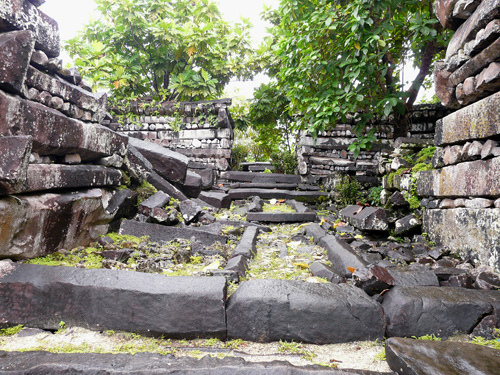
Ponape (Pohnpei) = eastern "island where there is an ancient ruin" (Nan Madol, check it out HERE)
~ Not immediately in the Kingdom (may be, if desired) ~
Indonesia & New Guinea = "larger islands in the south"
Also, Christ says that any other land can join if they desire but don't really need to since He will establish many kingdoms in many lands according to the different people there, and they will all be united anyway after He returns.

Christ finishes this segment with a curse upon anyone who keeps the people of this kingdom down, that they will lose their power and be cast down and trodden upon, for all these lands are given to Christ by the Father and preserved as an inheritance for the Gentiles who are bound through the remnant of the Tribes of Israel. God remembers His covenants to Israel and promises to the Gentiles. I think there's a definite distinction between those last two phrases--covenants to Israel and promises to the Gentiles. God has always made personal covenants with His chosen people, but there are none, necessarily, to the Gentiles until they are adopted into the House of Israel and choose Him as their God. At the same time, this was one of the main purposes of the scattering of Israel, that those remnants might become God's salt, light, and leaven to flavor, enlighten, and raise up all the peoples of the earth (see Matt 5, 13). This will also be a theme in the early parts of the Aklatan, as they recount the two primary waves of ancestors arriving in the islands.